A dog-friendly home for stiff joints: 12 small changes
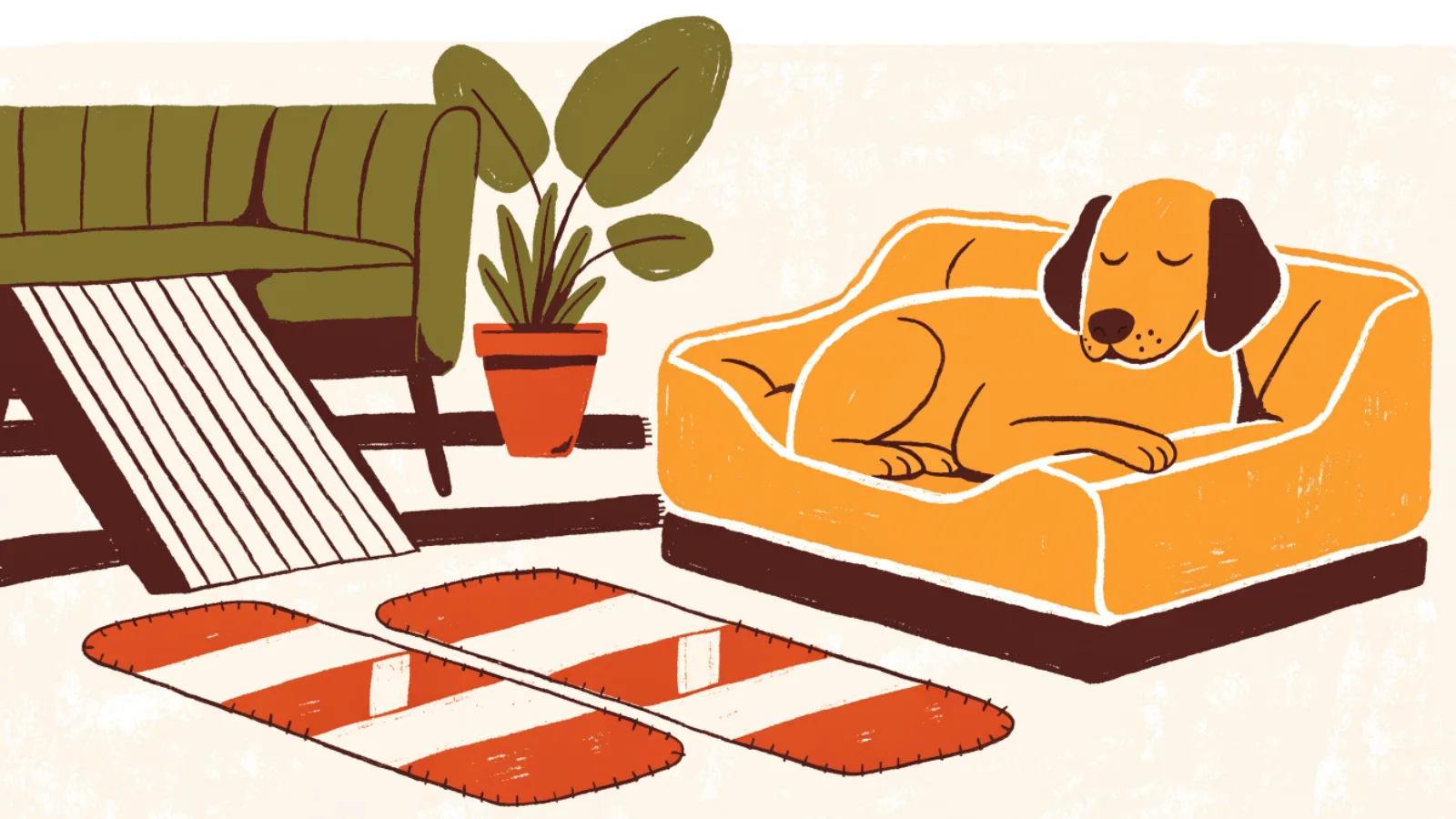
To help a senior dog with mobility at home, start with grip and height. Cover slick floors with non-slip rugs or runners, add a ramp or steps to the couch, bed and car, keep nails short, and give your dog a supportive bed in a warm, draft-free spot. Most changes take an afternoon and cost little.
Why does the home matter so much for a stiff dog?
Picture your dog's morning. They stand up on a slippery floor, splay a back leg, then scramble across the hallway like a cartoon character on ice. Then they wait at the foot of the couch, wondering whether today is a jumping day.
Small changes take a lot of that strain away. Canine Arthritis Resources and Education (CARE) says jumping down from a bed or out of an SUV "puts a lot of force on the joints and is not recommended for any dog" (CARE). Most of the fixes below take an afternoon.
Your dog lives at floor level. Get down there and look at your home from their eye level.
Walk-through: a 15-minute home audit
Do this once, with your dog if they are willing.
- Map the daily route (3 min). Bed, water, food, door, couch, your bed. These are the paths that need grip first.
- Test the floors (3 min). Walk the route in socks. Anywhere you slide, your dog slides.
- Count the jumps (3 min). Couch, bed, car, porch step. Each one is a candidate for a ramp or steps.
- Check the paws (2 min). Are nails clicking on the floor? Is fur growing over the pads?
- Sit in the bed spot (2 min). Is it drafty, near a door, on bare tile?
- Turn off the lights (2 min). Can you see the hallway and stairs at night?
What are the 12 changes?
| Change | Where | Effort |
|---|---|---|
| Rugs and runners | Slick floors | An afternoon |
| Ramp or steps | Couch, bed | An afternoon |
| Raised bowls (if vet agrees) | Feeding spot | 10 minutes |
| Orthopedic bed, well placed | Living room, bedroom | 30 minutes |
| Nail trims and paw fur | Paws | 15 minutes, every few weeks |
| Night lights | Halls, stairs | 10 minutes |
| Baby gates | Stairs, slick rooms | 30 minutes |
| Harness with handle | On your dog | 10 minutes |
| Car ramp | Car | Practice over a week |
| Warm sleeping spot | Bed area | 10 minutes |
| Food and water on each floor | Each level | 10 minutes |
| Yard path | Garden | A weekend |
1. Rugs and runners on slick floors
CARE suggests covering tile, hardwood and vinyl "with rugs, runners, yoga mats or gym floor tiles," always with a non-skid pad underneath (CARE). A BluePearl vet suggests runners that create "a path for your pet to follow" to food, beds and the door (BluePearl).
2. Ramps or steps for the couch and bed
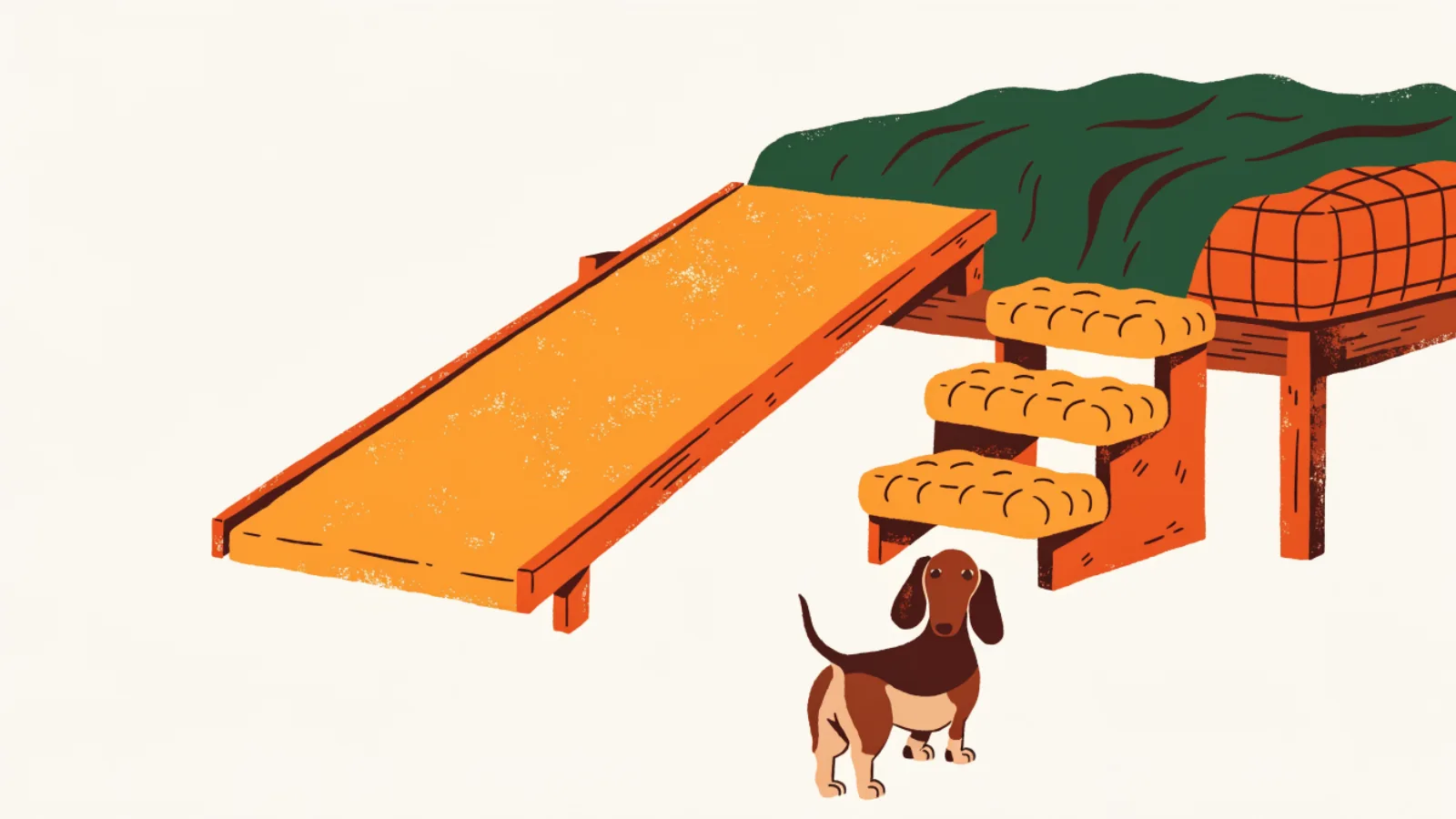
CARE advises stairs or ramps, especially for getting down, and describes the ideal ramp as wide, gently inclined, sturdy and slip-resistant (CARE). Teach it with treats one step at a time. If your dog has already stopped jumping, read what it can mean when a dog stops jumping on the couch.
3. Raised bowls, only if your vet suggests it
VCA says raised bowls "can reduce strain on the neck and back" (VCA), and CARE puts the ideal height at about the shoulders (CARE).
A rug or mat under the food bowl helps every dog keep four feet planted (BluePearl).
4. An orthopedic bed in the right spot
VCA recommends "an orthopedic or memory foam bed to reduce pressure on sore joints" (VCA). Placement matters as much as foam: CARE says beds belong in a warm, non-drafty spot with non-slick flooring around them (CARE). Low sides make stepping in easier.
5. Nail trims and paw fur
CARE says "it is very important to keep toenails trimmed short," because long nails change how the toes work and reduce traction (CARE). Long fur between the pads also costs grip. BluePearl says it "can be gently trimmed to the level of the pads" (BluePearl). A groomer or your vet clinic can do both.
6. Night lights
A vet-reviewed Dogster article says older dogs' vision "may start to become more blurry," and leaving a light on may help them get around without hurting themselves (Dogster). Plug-in lights in the hall and at the top of the stairs cost a few dollars. Keep furniture where it is, too. The AKC advises clear paths and a consistent layout for dogs with poorer eyesight (AKC).
7. Baby gates on stairs
VCA suggests blocking stairs "when no one is available to supervise," and gating off rooms with slick floors (VCA). CARE adds carpet or traction pads on the stairs you do use, and says small dogs should be carried (CARE).
8. A harness with a handle
CARE describes support harnesses with handles that help you lift your dog to stand, manage stairs or get into the car (CARE). Let your dog wear it around the house for a few short sessions first.
9. A car ramp
VCA says a vehicle ramp "can help reduce stress on the back and leg joints" (VCA). CARE is honest that no car ramp works for every dog, and that ramps "must also not be too steep" (CARE). Practice in the driveway with treats before the first vet trip.
10. A warm sleeping spot
"Cold, damp conditions may worsen stiffness and discomfort," according to VCA, which also advises against outdoor living for dogs with osteoarthritis (VCA). Move the bed away from doors and air vents and add a washable blanket.
11. Food and water on each floor
If stairs are hard, put a second water bowl and a bed upstairs. Fewer trips means fewer chances to slip.
12. A yard path
Canine Arthritis Management suggests "firm, predictable flat short grass" over hard or uneven ground, and warns that steps and drops can cause injuries (CAM). Mow a short-grass route to the potty spot and add a light by the back door. For pacing walks beyond the yard, see how far to walk an older dog.
Where can I buy rugs, ramps and beds?
Look for non-slip backing on rugs, a textured surface and gentle angle on ramps, and dense foam that does not flatten on beds.
What to do next
- Do the 15-minute audit this weekend and fix the top three slips first.
- Mention any changes to your vet, especially if your dog has started avoiding stairs or jumps. Our 8 everyday signs your dog's mobility is changing can help you describe them.
- Keep your dog moving gently. Try our 10 gentle games for older dogs on your new non-slip rug.
- If you are reading up on joint chews as part of your vet's plan, we explain how we chose the amounts in GoodYears Mobility openly, including where they fall below study levels.
Questions owners ask
Do dogs with stiff joints really slip more on hardwood?
Many do. Slick floors give little grip, and long nails or long fur between the pads make it worse. CARE calls floor traction perhaps its most important home recommendation for a dog with arthritis. Start with the routes your dog uses most: bed to water, water to the door.
Should I get a ramp or steps for the couch?
Either can work. Steps take less floor space and suit dogs who climb confidently. A ramp suits dogs who struggle to lift their legs or who are wobbly coming down. Look for a non-slip surface, a gentle angle and enough width for your dog. CARE notes that most dogs need some training to use a ramp, so practice with treats before you expect it.
Are raised dog bowls good for older dogs?
They can be comfortable. VCA says raised bowls can reduce strain on the neck and back, and CARE suggests a bowl at about shoulder height. But for large and giant breeds, studies on raised bowls and bloat are few and conflicting, so ask your vet before switching, especially if your dog is deep-chested.
Where should I put an orthopedic dog bed?
Somewhere warm, dry and draft-free, on a non-slip floor, and close to where the family spends time. CARE advises non-slick flooring under and around the bed so your dog can get up without slipping. If your dog sleeps on your bed, use stairs or a ramp so they are not jumping off.
Sources
- Lifestyle modifications for dogs with OA. Canine Arthritis Resources and Education, 2026
- Assistive devices for dogs with arthritis. Canine Arthritis Resources and Education, 2026
- Helping your dog with osteoarthritis (Weir, Williams, Downing). VCA Animal Hospitals, 2026
- Easy tips to prevent pet slips (Spade). BluePearl Pet Hospital, 2024
- Are dogs that are fed from a raised bowl at an increased risk of gastric dilation volvulus compared with floor-fed dogs? (Buckley). Veterinary Evidence, 2017
- Should I leave a light on for my dog at night? (reviewed by Dr. Kim Podlecki, DVM). Dogster, 2026
- Dog vision loss: signs, symptoms, and management (Gibeault). American Kennel Club, 2026
- Modifying exercise routines. Canine Arthritis Management, 2026
Keep reading
 Everyday signs and senior mobilityMy dog stopped jumping on the couch: what it can mean and what to doDog not jumping on the couch anymore? Common reasons, from sore joints and back pain to slippery floors, the red flags that need a vet, and how to help at home.
 Everyday signs and senior mobilityIs it just age? 8 everyday signs your dog's mobility is changingSigns your dog is slowing down: slower to get up, lagging on walks, pausing at stairs. What 8 everyday changes can mean, when to see a vet, and a monthly check.
 Ingredients and evidenceDo joint supplements work for dogs? What the research actually showsDo dog joint supplements work? Omega-3 has the strongest research, green-lipped mussel is mixed, glucosamine and chondroitin lean negative. See the evidence.
 Everyday life with an older dogDog ramp or dog stairs? How to choose (and what to measure first)Dog ramp vs stairs: which suits your dog's size, back and joints, what to measure before you buy, grip and weight limits, car ramps and how to train your dog.
This guide is general information for dog owners, not veterinary advice. If your dog is limping, in pain, or changes suddenly, see your vet. GoodYears Mobility is a supplement: these statements have not been evaluated by the FDA, and it is not intended to diagnose, treat, cure, or prevent any disease.