10 gentle games for older dogs (that still feel like play)
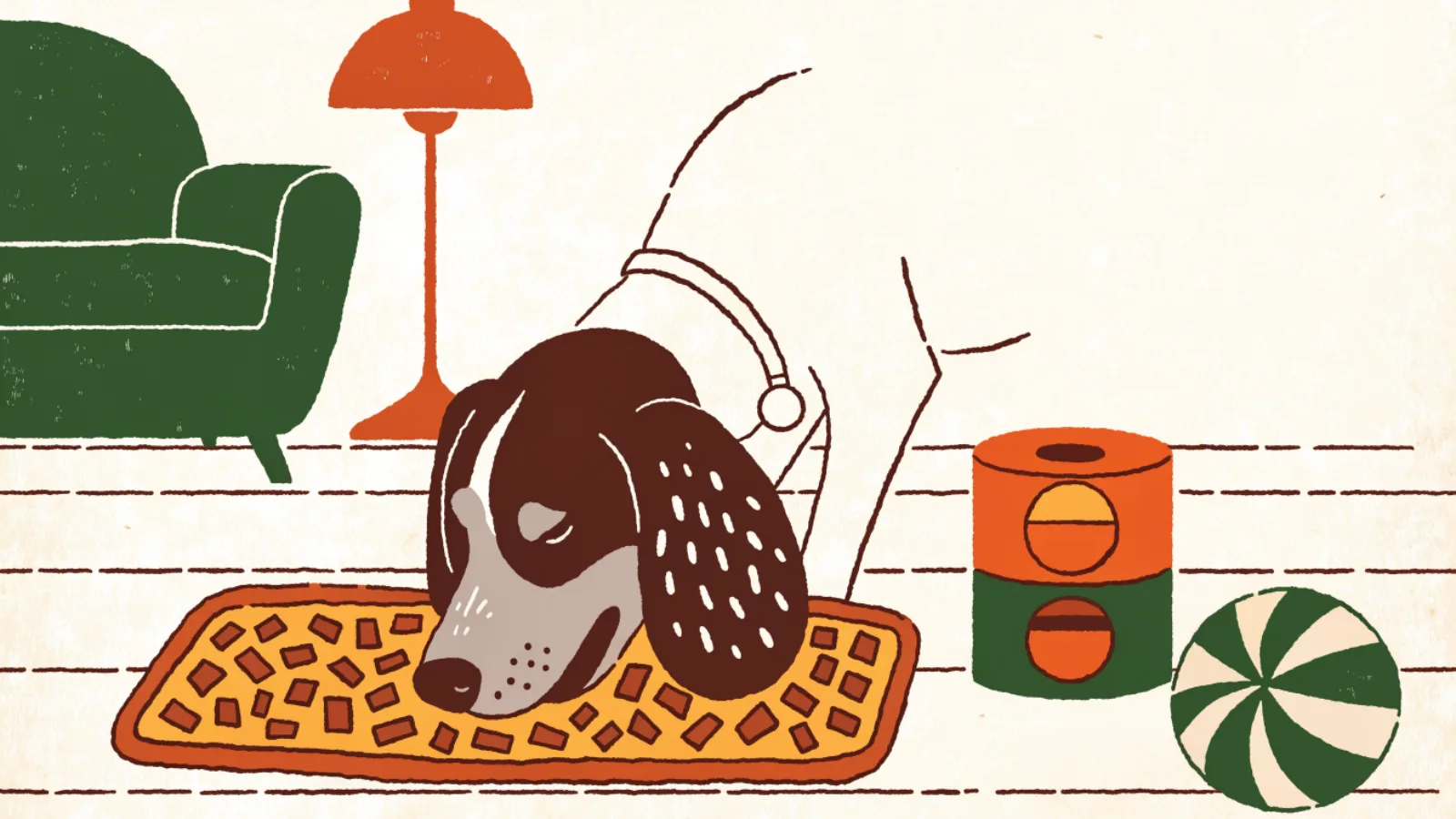
The gentlest games for senior dogs use the nose and the brain more than the legs. Sniffing games, snuffle mats, puzzle feeders, hide and seek, short trick sessions and slow sniff walks all give an older dog real play with very little jumping, twisting or sprinting. Keep sessions to 5 to 10 minutes on non-slip ground.
Why do older dogs still need play?
It is 4 p.m. Your dog has napped since lunch, and now they are staring at you with the look that says "and?" They still want fun. They just don't want to chase a ball forty times anymore, and honestly, their hips agree.
Good news: play does not have to mean running. Cornell's Riney Canine Health Center says "all dogs need and benefit from enrichment," and that for aging dogs, routine enrichment "can help keep their brain stimulated" (Cornell).
The nose is your secret weapon. In a 2019 study, pet dogs that did two weeks of daily nosework became more "optimistic" on a judgment test, while dogs that practiced heelwork did not change (Duranton and Horowitz).
For an older dog, ten minutes of sniffing is real play, not a consolation prize.
How do I keep games gentle for a stiff dog?
High-impact play is the main thing to drop. Canine Arthritis Resources and Education (CARE) advises avoiding "jumping down and ball play" for dogs with osteoarthritis (CARE). Canine Arthritis Management warns that ball-loving dogs "will run through discomfort and moderate pain," so you have to be the one who stops the game (CAM).
- Play on rugs, yoga mats or grass, never slick wood or tile
- Keep sessions short: 5 to 10 minutes, then rest
- No jumping up, jumping down or sharp spins
- Keep toys and treats at or below nose height
- Use part of the daily food, not extra food, and keep any treats small and dog-safe
- Stop if your dog limps, lags, pants hard or wanders off
- Check for extra stiffness later that day and the next morning
What games can I play with my senior dog?
Here are ten, roughly from least effort to most.
| Game | Effort | You need | Session |
|---|---|---|---|
| Snuffle mat | Very low | Mat, kibble | 5 min |
| Find it | Very low | Treats | 5 min |
| Puzzle feeder | Very low | Puzzle toy | 5 to 10 min |
| Box shredding | Low | Cardboard box, paper | 5 to 10 min |
| New tricks | Low | Treats | 3 to 5 min |
| Scent work | Low | Box, treat | 5 to 10 min |
| Hide and seek | Low | A helper or a stay | 5 min |
| Low tug | Low to moderate | Soft tug toy | 2 to 3 min |
| Slow fetch | Moderate | Ball, grass | A few rolls |
| Sniffari walk | Your dog decides | Leash | 10 to 20 min |
1. Snuffle mat
How to play: sprinkle a handful of kibble into a shaggy fabric mat and let your dog root it out. Cornell describes snuffle mats as "like extra shaggy rugs to hide food or treats" (Cornell). Why it suits an older dog: it happens lying down or standing still. All the work is in the nose. Keep it gentle: put the mat on a rug so it doesn't slide, and pick it up afterward so it doesn't become a chew toy.
2. Find it
How to play: let your dog watch you drop a treat a few feet away, say "find it," then gradually hide treats behind a chair leg or under a cup. Cornell suggests scattering food so your dog can "hunt and sniff for each piece" (Cornell). Keep it gentle: hide at floor level only. No treats on sofa cushions.
3. Puzzle feeders
How to play: load a puzzle toy with kibble and let your dog slide, lift or nudge to get it out. Cornell notes puzzle feeders "can be purchased or made," for example kibble in a muffin tin with tennis balls on top (Cornell). Keep it gentle: start with the easiest level. A frustrated dog paws harder.
4. Cardboard box shredding
How to play: put a few treats in a cardboard box with crumpled paper, a trick Cornell also suggests (Cornell). Let your dog rip it open. Keep it gentle: remove tape and staples, and stay nearby so paper is shredded, not swallowed.
5. New-trick training
How to play: teach a small trick, like nose to your palm, a chin rest on your knee or "which hand has the treat." Cornell says "you can still teach your old dog new tricks," because most learning takes little physical effort (Cornell). Keep it gentle: skip tricks with lots of sits, downs or spins. Three minutes is a full session.
6. Beginner scent work
How to play: line up three boxes, put a treat in one, and let your dog find it. Move to more boxes, then different rooms. This is the same sniffing that made dogs more optimistic in the 2019 study above. Keep it gentle: keep boxes on the floor and spaced out so your dog walks calmly between them.
7. Hide and seek
How to play: ask your dog to stay (or have someone hold them), hide behind a door, then call "find me." The AKC suggests starting with easy hiding spots and notes that even a dog who is hard of hearing "can still participate by using his nose to track you down" (AKC). Keep it gentle: hide on one floor only. No stairs.
8. Tug at low height
How to play: use a soft, long tug toy and let your dog pull while you mostly hold steady. Why it suits an older dog: it is short and satisfying for dogs who love to grab. Keep it gentle: keep the toy at or below nose height so your dog stays on all four feet, tug side to side rather than up and down, and let them win often.
9. Slow fetch on soft ground
How to play: roll, don't throw. VCA says ball and frisbee play is not recommended for dogs with osteoarthritis, and that if you do play, warm your dog up, check the footing "isn't slippery, angled, or bumpy," keep the ball low and keep throws few (VCA). Keep it gentle: play on flat grass, five or six rolls, then switch to a nose game. If your dog has been diagnosed with arthritis, ask your vet first.
10. Sniffari walks
How to play: a slow walk where your dog picks the route and sniffs as long as they like. Cornell's author describes her senior Pomeranian who "loved uninterrupted time to sniff" once long walks lost their appeal (Cornell). Keep it gentle: choose flat grass or a smooth path, and turn back before your dog slows. Our guide on how far to walk an older dog covers pacing.
Where can I buy a snuffle mat or puzzle feeder?
Look for a mat with a non-slip base that you can machine wash, and a puzzle with an easy first level. Avoid small parts your dog could chew off.
What to do next
- Pick two games from the list and try one today, one tomorrow.
- Watch the next morning. Extra stiffness means the game was too much. Make it shorter or swap it.
- Make home easier too. Our 12 small home changes for stiff joints help between games.
- Notice the bigger picture. If your dog has lost interest in play they used to love, read 8 everyday signs your dog's mobility is changing and mention it to your vet. If puzzle treats are adding up, the rib check shows how to tell if your dog is at a healthy weight.
Questions owners ask
How much mental stimulation does an older dog need?
There is no set number, so watch your dog rather than the clock. One or two short brain games a day, of 5 to 10 minutes each, is a sensible place to start. Cornell's Riney Canine Health Center says routine enrichment can help keep an aging dog's brain stimulated. If your dog loses interest, make the game easier, not longer.
Is fetch bad for older dogs?
Fast, repeated fetch is hard on stiff joints, because sprinting, sudden stops and leaping put a lot of force through the legs and back. VCA advises against ball and frisbee play for dogs with osteoarthritis, and suggests that if you do keep playing, you warm up first, roll the ball low and keep throws few. A rolled ball on grass, or a nose game, is the gentler swap.
Can a senior dog really learn new tricks?
Yes. Cornell notes that you can still teach an old dog new tricks because most learning does not take much physical effort. Pick tricks that involve little movement, such as touching your hand with their nose, chin rests or learning a toy's name, and keep each session to a few minutes with plenty of rewards.
Do snuffle mats and puzzle feeders make dogs gain weight?
Only if you add food on top of meals. Measure some of your dog's normal daily kibble into the mat or puzzle instead. If you use treats, UC Davis advises keeping treats and extras under 10% of daily calories. That way the game adds fun, not pounds.
Sources
- Canine enrichment ideas (Cohen). Cornell Riney Canine Health Center, 2023
- Let me sniff! Nosework induces positive judgment bias in pet dogs (Duranton and Horowitz, Applied Animal Behaviour Science). Purdue University Center for Animal Welfare Science, 2019
- Best toys and games for senior dogs (Arford). American Kennel Club, 2019
- Exercising dogs with osteoarthritis (Williams). VCA Animal Hospitals, 2026
- Modifying exercise routines. Canine Arthritis Management, 2026
- Ways to exercise a dog with osteoarthritis. Canine Arthritis Resources and Education, 2026
- Treat guidelines for dogs. UC Davis School of Veterinary Medicine, 2026
Keep reading
 Everyday signs and senior mobilityIs it just age? 8 everyday signs your dog's mobility is changingSigns your dog is slowing down: slower to get up, lagging on walks, pausing at stairs. What 8 everyday changes can mean, when to see a vet, and a monthly check.
 Everyday signs and senior mobilityMy dog stopped jumping on the couch: what it can mean and what to doDog not jumping on the couch anymore? Common reasons, from sore joints and back pain to slippery floors, the red flags that need a vet, and how to help at home.
 Choosing and using a joint chewHow long do joint supplements take to work in dogs?Sources say 4 weeks to 2+ months, and canine trials ran 6 to 13 weeks. See timelines by ingredient, a 30/60/90-day tracking checklist and when to see your vet.
 Everyday life with an older dogA dog-friendly home for stiff joints: 12 small changesHow to help a senior dog with mobility at home: 12 small changes, from non-slip rugs and couch ramps to orthopedic bed placement, plus a 15-minute home audit.
This guide is general information for dog owners, not veterinary advice. If your dog is limping, in pain, or changes suddenly, see your vet. GoodYears Mobility is a supplement: these statements have not been evaluated by the FDA, and it is not intended to diagnose, treat, cure, or prevent any disease.