The rib check: how to tell if your dog is a healthy weight (and why joints care)
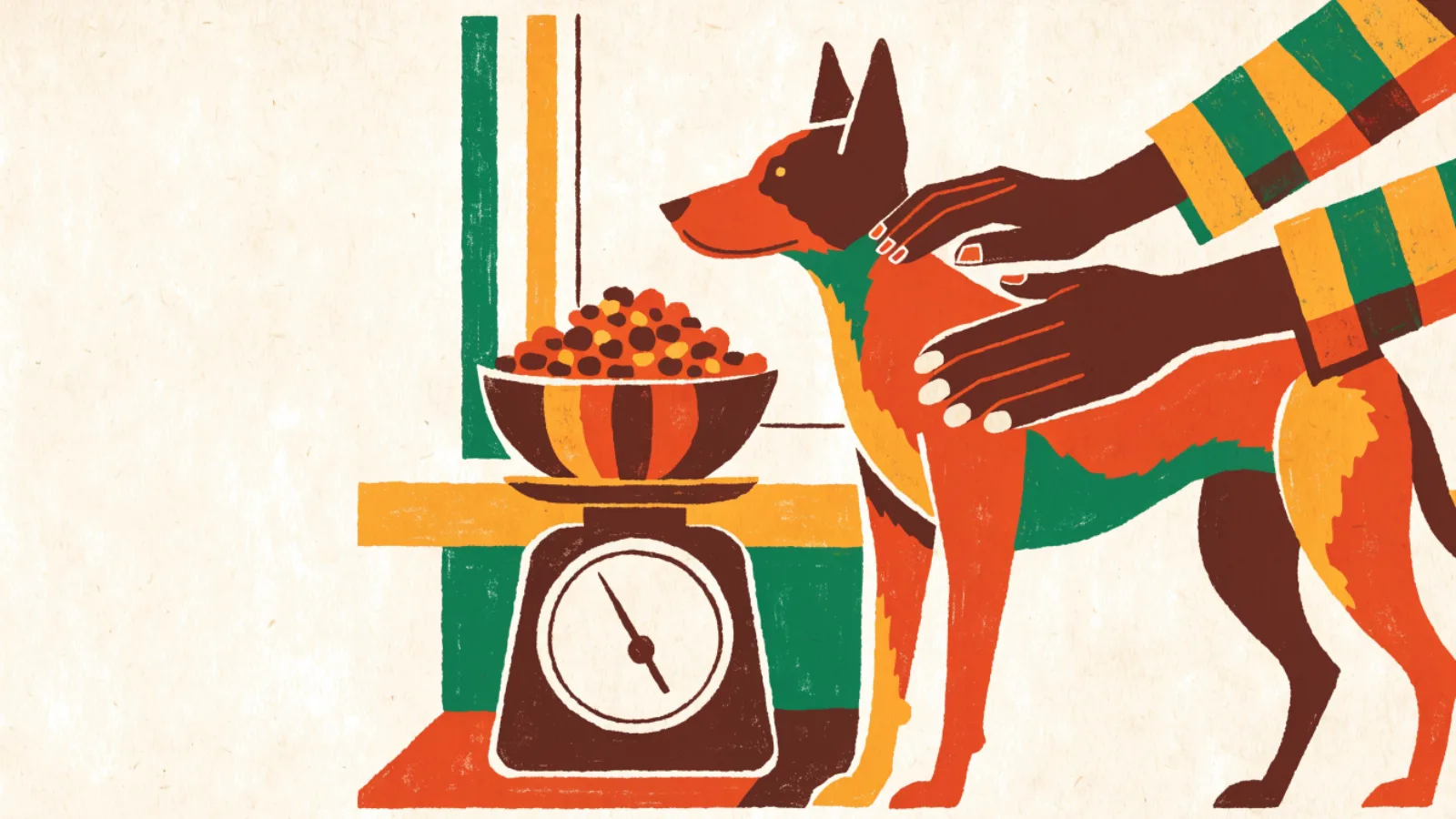
Run your hands along your dog's sides. At a healthy weight you can feel the ribs easily under a thin layer of fat, see a waist behind the ribs from above, and see the belly tuck up from the side. If you have to press to find the ribs, or there is no waist, your dog is probably overweight.
| US dogs overweight or obese | 59% (APOP, 2022, vet-assessed) |
|---|---|
| Ideal body condition score | 4 to 5 on a 1 to 9 scale |
| Each point above ideal | About 10% extra body weight (Cornell) |
| Treats and extras | No more than 10% of daily calories (UC Davis) |
How can I tell if my dog is overweight?
Your dog flops down next to you, and you give their side a friendly rub. Quick question: did you feel ribs, or did you feel a nice, cushy sofa? That one pat holds most of the answer.
Vets use a body condition score, usually on a 1 to 9 scale, and you can do a home version in 30 seconds. On the World Small Animal Veterinary Association (WSAVA) chart, 4 and 5 are ideal, with ribs "easily palpable, with minimal fat covering" at a 5 (WSAVA).
The rib check, in plain words
Do this with your dog standing.
- Ribs: flat hands on the chest, light pressure. You should feel each rib, like the back of your hand, not your knuckles or your palm.
- Waist: look down from above. You should see an hourglass dip behind the ribs.
- Tuck: look from the side. The belly should rise up from the chest toward the back legs.
- Base of the tail and lower back: no soft pads of fat.
Cornell's Riney Canine Health Center describes the ideal the same way: ribs that can "be felt but not seen" and "a tucked waist when viewed from above" (Cornell).
| Score (1 to 9) | Ribs | Waist from above | Tuck from side |
|---|---|---|---|
| 1 to 3, underweight | Easily seen | Very obvious | Extreme |
| 4 to 5, ideal | Easy to feel, thin fat cover | Clear | Clear |
| 6, overweight | Felt with slight extra fat | Visible but faint | Present |
| 7, overweight | Hard to feel, heavy fat | Barely visible or gone | May be present |
| 8 to 9, obese | Not felt without firm pressure | None | None, belly may hang |
Simplified from the WSAVA chart (WSAVA).
Cornell adds that each point away from ideal is about 10% of body weight (Cornell). So a dog at a 7 may be carrying about 20% more than they should.
How common is it for dogs to be overweight?
Very. In the Association for Pet Obesity Prevention's 2022 survey, vets scored 59% of dogs as overweight or obese: 37% overweight and 22% obese (APOP).
If your dog fails the rib check, you are in large company. It is also very fixable.
Why do joints care about weight?
Every extra pound rides on the same hips, knees and elbows. Cornell says extra weight "increases the stress on the dogs' bones, joints and muscles, making the risks of arthritis worse" (Cornell). VCA says a lean body condition "is one of the best ways to reduce stress on arthritic joints" (VCA).
What did the Purina lifetime study find?
The best-known evidence comes from a study that followed dogs for their whole lives. Researchers paired 48 Labrador retrievers from seven litters. From 8 weeks old, one dog in each pair ate 25% less than its littermate (Penn Today).
The results were published in JAVMA in 2002 (Kealy et al.):
- Longer lives. The leaner dogs lived a median of 13 years, against 11.2 years for their littermates, about 1.8 years longer (Penn Today).
- Later joint trouble. Fewer of the leaner dogs showed hip osteoarthritis on X-rays, and on average they did not need treatment for osteoarthritis until 13.3 years old (Penn Today).
Keep it in proportion: this was one breed, in one research colony, run by Purina researchers. Still, it is one of the clearest long-term looks at weight and aging in dogs.
A lean dog is not a hungry dog. It is a dog whose joints carry less every single step.
How do I help my dog lose weight?
Start with your vet, who can confirm the score, rule out medical causes and set a target weight. Then these steps do most of the work.
- Weigh the food, don't scoop it. In a 2019 University of Guelph study, owners measuring dry dog food with three common measuring devices were off by anywhere from 48% under to 152% over (OVC Pet Nutrition). An inexpensive kitchen scale fixes that.
- Set a treat budget of 10%. UC Davis says treats and extras "should not exceed 10% of the daily caloric intake" (UC Davis). Low-calorie swaps like baby carrots or plain green beans, in small amounts, help if your vet agrees.
- Feed games, not just bowls. Put part of each meal in a snuffle mat or puzzle. Our 10 gentle games for older dogs uses dinner as the prize.
- Weigh monthly. Same scale, same time of day. Write it down with the rib check score.
- Move a little more, gently. Short, regular walks beat weekend marathons. See how far to walk an older dog.
What to do next
- Do the rib check tonight and write down a score.
- Weigh the food at the next meal and compare it to the bag's guide and your vet's advice.
- Make moving easier. If your dog is reluctant to jump or climb, see what it can mean when a dog stops jumping on the couch and our 12 home changes for stiff joints.
- Watch for other early changes with 8 everyday signs your dog's mobility is changing.
Questions owners ask
What is a body condition score for dogs?
It is a hands-on way vets rate body fat, usually on a 1 to 9 scale. On the WSAVA chart, 4 and 5 are ideal: ribs easy to feel with little fat cover, a visible waist from above and a belly tuck from the side. Scores of 6 and 7 are overweight, and 8 and 9 mean heavy fat cover with no waist. Your vet can score your dog in a minute.
How fast should my dog lose weight?
Slowly, and with a plan from your vet. Your vet can confirm the body condition score, set a target weight, work out a daily calorie amount and check progress at regular weigh-ins. Ask before you cut portions sharply on your own, especially for a senior dog or one with health conditions, and keep using the rib check at home between visits.
My dog looks fine to me. Can they still be overweight?
Yes. Fluffy coats hide a lot, and when most dogs around you are a little heavy, a little heavy starts to look normal. In APOP's 2022 vet-assessed survey, 59% of dogs were overweight or obese. That is why the hands-on rib check is more reliable than looking.
Does extra weight really affect a dog's joints?
Vet sources say it does. Cornell's Riney Canine Health Center says extra weight increases the stress on a dog's bones, joints and muscles, and VCA calls a lean body condition one of the most effective ways to reduce stress on arthritic joints. In Purina's lifetime study of Labradors, the leaner dogs needed treatment for osteoarthritis later on average.
Sources
- WSAVA body condition score chart: dogs. World Small Animal Veterinary Association, 2013
- Obesity and our dog's health (Cohen). Cornell Riney Canine Health Center, 2023
- 2022 pet obesity prevalence survey. Association for Pet Obesity Prevention, 2022
- Effects of diet restriction on life span and age-related changes in dogs (Kealy et al., J Am Vet Med Assoc 220:1315 to 1320). PubMed, 2002
- Study finds dogs fed reduced-calorie diet live nearly two years longer than dogs on unrestricted diet. Penn Today, University of Pennsylvania, 2002
- Helping your dog with osteoarthritis (Weir, Williams, Downing). VCA Animal Hospitals, 2026
- Treat guidelines for dogs. UC Davis School of Veterinary Medicine, 2026
- My cup runneth over (on Coe et al., Vet Record 2019). Ontario Veterinary College Pet Nutrition, University of Guelph, 2019
Keep reading
 Everyday signs and senior mobilityIs it just age? 8 everyday signs your dog's mobility is changingSigns your dog is slowing down: slower to get up, lagging on walks, pausing at stairs. What 8 everyday changes can mean, when to see a vet, and a monthly check.
 Everyday signs and senior mobilityMy dog stopped jumping on the couch: what it can mean and what to doDog not jumping on the couch anymore? Common reasons, from sore joints and back pain to slippery floors, the red flags that need a vet, and how to help at home.
 Ingredients and evidenceDo joint supplements work for dogs? What the research actually showsDo dog joint supplements work? Omega-3 has the strongest research, green-lipped mussel is mixed, glucosamine and chondroitin lean negative. See the evidence.
 Everyday life with an older dogA dog-friendly home for stiff joints: 12 small changesHow to help a senior dog with mobility at home: 12 small changes, from non-slip rugs and couch ramps to orthopedic bed placement, plus a 15-minute home audit.
This guide is general information for dog owners, not veterinary advice. If your dog is limping, in pain, or changes suddenly, see your vet. GoodYears Mobility is a supplement: these statements have not been evaluated by the FDA, and it is not intended to diagnose, treat, cure, or prevent any disease.