Dog ramp or dog stairs? How to choose (and what to measure first)
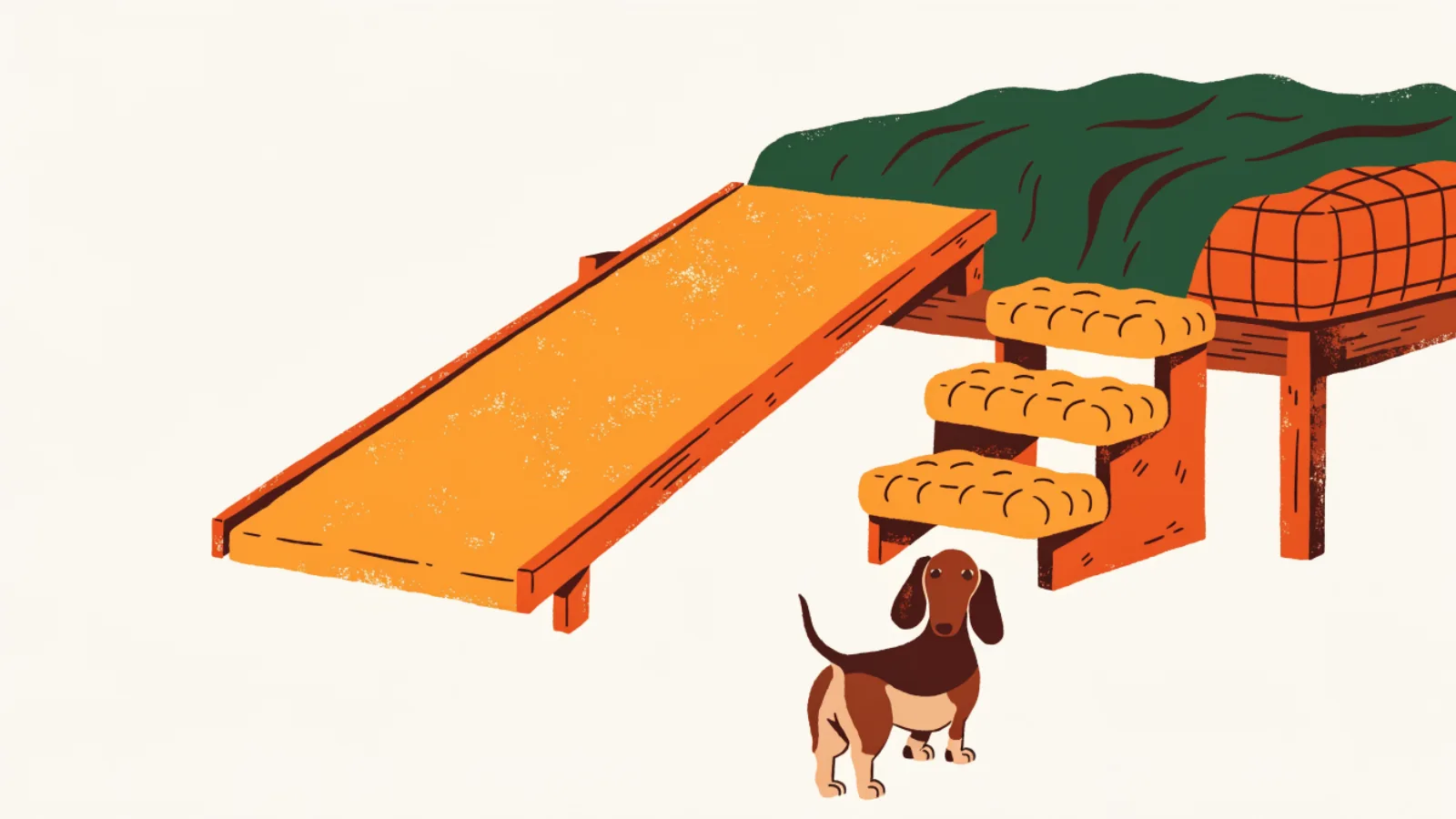
Choose a ramp if your dog has arthritis, a back condition or a long back, or is medium to large: PetMD says ramps are recommended over stairs for joint or back conditions. Stairs suit small, agile dogs and tight rooms. Measure the height first, then pick the longest ramp your floor allows, since longer means gentler.
| Joint or back issues | Ramp recommended over stairs (PetMD) |
|---|---|
| Small, agile dogs | Usually fine on stairs (PetMD) |
| Measure first | Height to the surface, floor space, your dog's width and weight |
| Look for | Non-slip surface, low incline, raised sides, a weight limit above your dog's weight |
Dog ramp or dog stairs: which should I choose?
Your dog stands at the side of the bed, looks up, looks at you, and waits. The leap that used to be nothing now takes a little run-up, or does not happen at all. You are not going to lift them up every night forever, so it is time for a ramp or a set of stairs.
Both help. Cornell's veterinarians recommend "non-slip rugs and ramps to get on beds, couches or cars" for dogs with osteoarthritis (Cornell), and the AKC says ramps and stairs "reduce joint pain and strain caused by jumping on and off sofas, beds, car seats" (AKC). The question is which one fits your dog and your room.
The short version, from a veterinarian writing for PetMD: "If a pet has arthritis or any other pre-existing joint or back conditions, a ramp is recommended over stairs," while "small dogs generally do well with stairs" (PetMD).
If your dog has suddenly stopped jumping up, read what it can mean when your dog stops jumping on the couch before you buy anything, since a vet check may come first.
Ramp vs stairs: how do they compare?
| Your dog or home | Ramp | Stairs |
|---|---|---|
| Arthritis or stiff joints | Recommended (PetMD); sloping ramps are gentler on sore joints (AKC) | Fine for a small dog who is steady on them |
| Long back or back condition (dachshund, corgi, basset) | Recommended for back conditions (PetMD) | Better than jumping; ask your vet |
| Small, agile dog | Works | Usually a good fit (PetMD) |
| Medium or large dog | Usually easier on joints (PetMD) | Can feel cramped |
| Nervous dog | Often adapts better (AKC) | Some dogs find steps scary |
| Small room | Needs a long run of floor | Takes less floor if it stays by the bed (AKC) |
| Car or travel | Folds, lighter, more portable (AKC) | Bulkier |
The research on everyday habits is less clear than the advice you will read online. A 2016 survey of 2,031 dachshunds (DachsLife) found that dogs exercised for more than an hour a day had lower odds of disc disease. It found no significant link with stair use, and dogs not allowed to jump on and off furniture actually had higher odds (Packer et al.). The authors stress this may be reverse causality, since owners often change the rules after a diagnosis, and say firm recommendations cannot be drawn. So: follow your own vet's advice, keep your dog active, and use a ramp or stairs to take out the big jumps.
What should I measure before buying a dog ramp or stairs?
Grab a tape measure. Five numbers decide almost everything.
- Height: floor to the top of the mattress, couch seat or car floor. Measure with the cushion pressed down a little, the way it sits under your dog.
- Floor run: how far out from the bed or couch you can place the ramp without blocking a door or walkway.
- Your dog's width: across the shoulders. The AKC warns that narrow stairs can make a dog lose confidence and fall off the side (AKC).
- Your dog's weight: then check the product's weight limit. The AKC notes that a flimsy ramp can snap under a giant breed (AKC).
- Your dog's stride: for stairs, watch how they step up a curb or a single stair. Low risers and deep treads give short legs more room.
How steep should a dog ramp be?
We could not find a vet source that gives one ideal angle. The guidance is qualitative: a dvm360 article by a veterinarian says ramps "should have a low grade of incline, be wide, and ideally have raised sides" (dvm360), and the AKC suggests starting at a low angle for training (AKC).
What the tape measure can tell you is geometry: for the same height, a longer ramp is a gentler slope. Here is what common sizes work out to (our calculation, not a vet recommendation):
| Surface height | 4 ft ramp | 5 ft ramp | 6 ft ramp |
|---|---|---|---|
| 18 in (low couch) | about 22° | about 17° | about 14° |
| 24 in (typical bed) | about 30° | about 24° | about 19° |
| 30 in (tall bed or SUV floor) | about 39° | about 30° | about 25° |
A 6 ft ramp needs roughly 5.5 to 6 ft of clear floor. If you do not have that, stairs with shallow steps may be the better fit, or a lower bed or couch.
What features matter most?
- Grip. A non-slip surface helps "prevent slipping and help build your dog's confidence" (AKC). Carpet, rubber or ridged treads all work. If your dog slides, PetMD suggests adding grip pads (PetMD).
- Stability. It should not wobble or creep across the floor. Non-slip feet help.
- Raised sides or a wall. dvm360 suggests raised sides (dvm360), and the AKC suggests placing ramps or stairs against a barrier on at least one side (AKC).
- Weight limit. Comfortably above your dog's weight.
- Adjustability. An adjustable-height ramp can move between bed, couch and car.
How do I train my dog to use a ramp or stairs?
Most dogs need a few days. PetMD notes that some dogs feel "frightened or nervous" at first, and it may take trying more than one product (PetMD). These steps follow the AKC's training advice (AKC).
- Let them explore. Set the ramp flat on the floor or the stairs in the middle of the room. Let your dog sniff it, and reward any interest.
- Lure one paw at a time. Use treats or a favorite toy. Reward every step with praise.
- Add a little height. Raise the ramp to a low angle against a step or the couch. Keep a wall on one side.
- Go all the way up. Once they walk it calmly, place it at full height. Reward at the top.
- Practice the way down. Coming down is often harder. Go slowly and reward at the bottom.
- Keep sessions short. A few minutes, a few times a day. Never push, pull or scold.
What about a dog ramp for the car?
For cars, ramps usually win. The AKC says ramps are often lighter than quality dog stairs and easier to fold, and recommends a "fold-away, lightweight, adjustable-angle portable ramp" if you will use it in several places (AKC). It adds that for a large dog with a big jump into a trunk, a ramp saves their joints, and that lifting a heavy dog "can be dangerous for you both."
Measure from the ground to the car floor or trunk lip. SUVs are often tall, so look at longer ramps. Practice on level ground with the car parked and the engine off.
The links above are searches, not picks. Use your measurements to filter by length, height and weight limit, and read the listed weight capacity before you buy.
What to do next
- Measure tonight: height, floor run, your dog's width and weight.
- Decide: ramp for joint or back issues and bigger dogs, stairs for small agile dogs or tight spaces.
- Train for a week with the steps above.
- Look at the rest of the house: our guide to a dog-friendly home for stiff joints covers floors, beds and bowls.
- See your vet for any sudden, severe or one-sided limp, or back pain, and read 8 everyday signs your dog's mobility is changing. For low-impact exercise, see swimming for dogs.
Questions owners ask
Are ramps or stairs better for dogs with arthritis?
Ramps, in most cases. PetMD, in an article by a veterinarian, says that for a pet with arthritis or another joint or back condition, a ramp is recommended over stairs. The AKC describes sloping ramps as gentler on sore joints. Stairs can still work for a small dog who is steady on them. Ask your vet if you are unsure.
What is the best dog ramp for a bed?
There is no single best ramp; the right one fits your bed height, your floor space and your dog. Look for a ramp long enough for a gentle slope, a non-slip surface, a width that fits your dog comfortably, raised sides and a weight limit above your dog's weight. A dvm360 article by a veterinarian recommends low incline, wide ramps with raised sides.
Should dachshunds use stairs?
A veterinarian quoted by the AKC says vets often recommend ramps or stairs for breeds prone to back problems, such as dachshunds. The evidence on stairs themselves is not settled: a 2016 survey of 2,031 dachshunds found no significant link between stair use and disc disease, and its authors said firm advice could not be drawn. Follow your own vet's advice, especially after any back episode.
How do I get my dog to use a dog ramp for the car?
Practice at home first with the ramp flat on the floor, then at a low angle against a step, rewarding every paw. Once your dog walks it calmly, set it against the car on level ground, hold the leash loosely and guide them up with treats. The AKC says to start with a low angle and raise it slowly as confidence grows.
Sources
- Does Your Dog Need Dog Stairs or a Ramp?. American Kennel Club, 2026
- Does My Dog Need Dog Stairs or a Dog Ramp?. PetMD, 2025
- Home hacks for geriatric dogs and cats. dvm360, 2025
- Intervertebral Disc Disease. American College of Veterinary Surgeons, 2023
- DachsLife 2015: an investigation of lifestyle associations with the risk of intervertebral disc disease in Dachshunds (Packer et al.). Canine Genetics and Epidemiology, 2016
- Osteoarthritis. Cornell University College of Veterinary Medicine, 2025
Keep reading
 Everyday signs and senior mobilityMy dog stopped jumping on the couch: what it can mean and what to doDog not jumping on the couch anymore? Common reasons, from sore joints and back pain to slippery floors, the red flags that need a vet, and how to help at home.
 Everyday life with an older dogA dog-friendly home for stiff joints: 12 small changesHow to help a senior dog with mobility at home: 12 small changes, from non-slip rugs and couch ramps to orthopedic bed placement, plus a 15-minute home audit.
 Everyday signs and senior mobilityIs it just age? 8 everyday signs your dog's mobility is changingSigns your dog is slowing down: slower to get up, lagging on walks, pausing at stairs. What 8 everyday changes can mean, when to see a vet, and a monthly check.
 Everyday life with an older dogSwimming for dogs: the low-impact exercise owners overlookIs swimming good for dogs with stiff joints? Why vets use water in rehab, how to start safely, who should skip it, pool vs lake, and how to find a rehab pool.
This guide is general information for dog owners, not veterinary advice. If your dog is limping, in pain, or changes suddenly, see your vet. GoodYears Mobility is a supplement: these statements have not been evaluated by the FDA, and it is not intended to diagnose, treat, cure, or prevent any disease.