Why is my dog stiff after sleeping? What owners notice, what vets check, and a simple daily routine
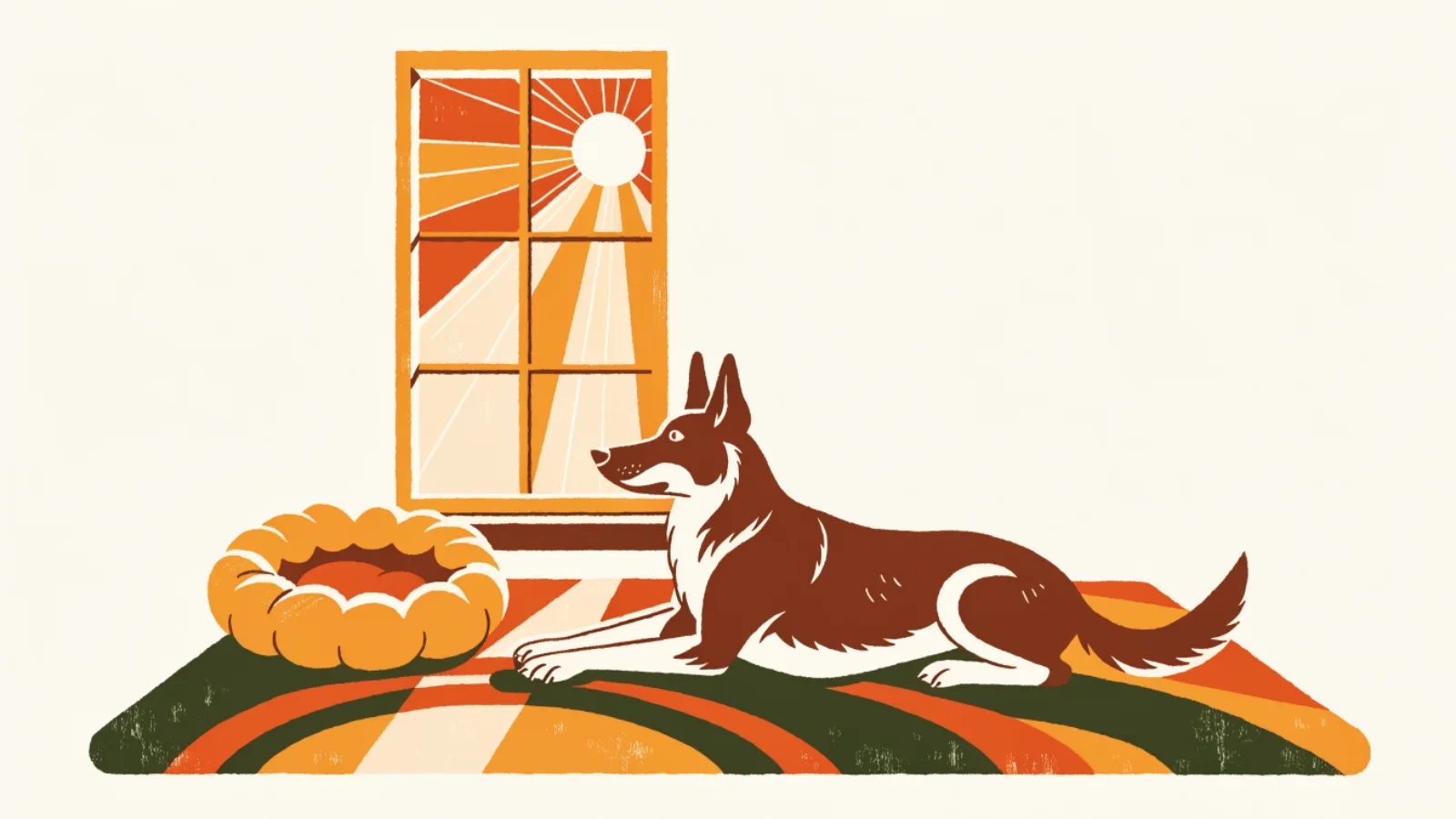
Stiffness after sleeping that eases after a few minutes of moving is common in older dogs, and joint wear (osteoarthritis) is a frequent reason. Extra weight, lost muscle and slippery floors can add to it. See a vet promptly if the stiffness is sudden, severe, one-sided, or in a young dog.
| Classic pattern | Stiff on rising, looser after a few minutes of moving |
|---|---|
| See a vet soon | Limping that does not settle within an hour, or sudden, severe or one-sided limping |
| What vets often start with | Exam, weight, low-impact exercise, non-slip floors |
| Supplement timing | No change expected before 1 month; about 2 months for green-lipped mussel (CARE) |
Why is my dog stiff after sleeping?
You know the moment. Your dog wakes from a nap, pushes up with the front legs first and takes a few slow, careful steps. There is a long stretch, maybe a small groan.
At the bottom of the stairs your dog pauses, as if working out a plan. Ten minutes into the walk, everything looks almost normal again.
That pattern, stiff after rest and looser after moving, is one of the classic things owners notice. PetMD describes a limp that can be worse when a dog first rises and less noticeable once it "warms up" by moving around (PetMD). VCA's veterinarians list "reluctance to get up, once lying down", groaning when standing up or lying down, and using the front legs to pull up to standing instead of pushing with the back legs as possible signs of discomfort (VCA, 2025).
None of this is a diagnosis. It is a reason to look closer, and to ask your vet.
What are the common reasons a dog is stiff after rest?
Stiffness after sleeping usually has more than one contributor. In general terms, these are the ones vets tend to consider.
- Joint wear (osteoarthritis). Canine Arthritis Resources and Education (CARE) calls arthritis the leading cause of chronic pain in dogs and says most dogs are not diagnosed until 8 to 10 years old (CARE). Cornell lists stiffness, trouble on stairs and "difficulty getting up from lying down" among its signs (Cornell, 2025).
- Extra weight. The AKC notes that excess weight on damaged joints is painful and can speed cartilage breakdown (AKC, 2026).
- Lost muscle. VCA lists weight gain and loss of muscle over the limbs and spine among early signs of osteoarthritis (VCA). Less muscle means less support each time your dog stands up.
- Slippery floors and hard beds. A veterinarian writing for dvm360 notes that arthritis and joint issues make it hard for senior pets to move on slippery surfaces (dvm360, 2025).
- The back, the neck, or a specific injury. PetMD notes that changes in the spine can cause a hunched posture or hind-leg weakness (PetMD). Only a vet can sort these out.
Age is part of the picture, but not all of it. CARE cites research finding that 40% of dogs under 4 years old had evidence of arthritis on X-rays (CARE). A young dog who is stiff after sleeping deserves a vet visit, not a wait-and-see.
When is stiffness after sleeping a reason to see the vet?
Raise gradual stiffness at your next appointment. Some situations should not wait.
- See a vet soon if a limp does not settle within an hour, or your dog seems sore when you touch the neck or back (VCA urgent care).
- Go to an emergency hospital if your dog cannot stand or walk without help, or is limping after major trauma, such as being hit by a car (VCA urgent care).
- Also call your vet for stiffness that appears suddenly, a limp that is severe or on one side only, a young dog with any mobility change, or stiffness alongside eating less or panting while resting (VCA, 2025).
Answering an owner's question for Dogster in 2026, veterinarian Dr. Paola Cuevas wrote that "a consistent limp in a hind limb warrants a physical examination and possibly radiographs" (Dogster).
What do vets check, and what do they usually recommend first?
Expect your vet to watch your dog walk, examine joints and muscles, check weight and, if needed, take X-rays. CARE describes vets suspecting arthritis from the signs and a physical exam, then confirming it on X-rays (CARE).
The first recommendations are rarely a product. They are usually these:
| What vets often start with | What it looks like at home | Source |
|---|---|---|
| Weight control | A lean body condition, set with your vet's diet plan | AKC, Cornell |
| Low-impact exercise | Regular leash walks, swimming | Cornell |
| Better footing | Non-slip rugs, runners, ramps | Cornell, dvm360 |
| Rehabilitation | Range-of-motion work, underwater treadmill | Cornell |
| Prescription pain options | NSAIDs, gabapentin, amantadine or a monthly injection, with blood work for long-term NSAID use | Cornell, AKC |
Do joint supplements help a dog that is stiff after sleeping?
The honest answer: the research is modest and mixed, it depends on the ingredient, and nearly every trial enrolled dogs already diagnosed with osteoarthritis. No study tested GoodYears Mobility.
- Omega-3 (fish oil) has the strongest support. A 2022 meta-analysis of 72 trials found only 2 of 20 omega-3 trials non-effective (Barbeau-Grégoire et al.). A 2012 systematic review rated the evidence "low for all nutraceuticals except for omega-3 fatty acid in dogs" (Vandeweerd et al.).
- Glucosamine and chondroitin are mixed, leaning negative for pain. In the same 2022 meta-analysis, 88.9% of glucosamine/chondroitin trials showed no effect, and the authors said these products "should no longer be recommended for pain management" in canine and feline osteoarthritis (Barbeau-Grégoire et al.). A 2003 randomized trial in 71 dogs with osteoarthritis found that a glucosamine, chondroitin and manganese product did not improve force-plate gait, while carprofen and meloxicam did (Moreau et al.).
- Green-lipped mussel is modest and mixed. A 2006 trial in 81 dogs with presumed joint disease found no difference at day 28; by day 56, owners reported more improvement with mussel (p=0.018), while the vets' score was only marginal (p=0.053) (Pollard et al.). A 2009 trial in 45 dogs with osteoarthritis found better mobility and pain scores than placebo, no force-plate difference, and a smaller effect than carprofen (Hielm-Björkman et al.).
- MSM has no canine efficacy research. dvm360 reports "no published research on the use of these supplements in dogs" (dvm360), and the 2022 meta-analysis found MSM only inside multi-ingredient products (Barbeau-Grégoire et al.).
Timing matters too. CARE says not to expect improvement from oral joint supplements before 1 month, with green-lipped mussel effects at about 2 months (CARE). Our guide on how long joint supplements take to work covers this by ingredient, and what the research on dog joint supplements actually shows goes deeper on every study.
What does a simple daily routine look like?
None of these needs a prescription.
- Give the first minute. Let your dog stand, stretch and walk around before you ask for stairs, a jump into the car or a game of fetch.
- Fix the footing. Put runners or yoga mats on slippery routes, and consider an orthopedic or memory foam bed (dvm360).
- Walk often, gently. Regular low-impact walks are what Cornell lists first under lifestyle (Cornell).
- Keep your dog lean. Ask your vet what a healthy weight looks like for your dog.
- Write it down. Once a week, note how your dog gets up, handles stairs and the couch, and how long walks last. Our list of everyday signs your dog's mobility is changing gives you the checklist, and what it can mean when your dog stops jumping on the couch covers one of the most common changes.
- Add a daily joint chew if you and your vet decide it fits. Think of it as one small part of the routine, not the whole plan.
What is GoodYears Mobility, and why is it dosed by weight?
GoodYears is made for Sir Oliver, our founder's young Vizsla, and in memory of Dari, the family pug who lived 15 happy years.
Four ingredients, every amount printed. Each 4 g duck-flavored soft chew contains glucosamine HCl 500 mg, MSM 400 mg, green-lipped mussel (Perna canaliculus) 150 mg and chondroitin sulfate 110 mg, plus vitamin C 20 mg and manganese 2.5 mg. Many joint chews lean mostly on glucosamine, and some listings do not show milligrams for every active. That does not mean those chews do not work; it means you cannot compare them easily.
Dosed by weight. On a one-a-day chew given to every size of dog, a 90 lb dog gets a third as much per pound as a 30 lb dog. Mobility scales with your dog instead:
| Dog weight | Chews a day | Glucosamine HCl | MSM | Green-lipped mussel | Chondroitin | One jar lasts |
|---|---|---|---|---|---|---|
| Up to 15 lbs | 1 | 500 mg | 400 mg | 150 mg | 110 mg | 60 days |
| 15 to 45 lbs | 2 | 1,000 mg | 800 mg | 300 mg | 220 mg | 30 days |
| 45 to 75 lbs | 3 | 1,500 mg | 1,200 mg | 450 mg | 330 mg | 20 days |
| Over 75 lbs | 4 | 2,000 mg | 1,600 mg | 600 mg | 440 mg | 15 days |
Daily amounts at the label dose of GoodYears Mobility (per chew: glucosamine HCl 500 mg, MSM 400 mg, green-lipped mussel 150 mg, chondroitin sulfate 110 mg). Contains shellfish. Check with your vet first if your dog takes any medication.
If your dog needs more than one chew, split them between morning and evening. One 60-chew jar lasts 60, 30, 20 or 15 days depending on weight band.
See our daily amounts FAQ and glucosamine amounts by weight for the arithmetic.
Who should check first. Mobility contains shellfish: the glucosamine comes from shrimp and crab, and the mussel is a shellfish too. PetMD advises avoiding glucosamine (PetMD) and green-lipped mussel (PetMD) in dogs with a shellfish allergy. Inactive ingredients include oat flour, rye flour and soy lecithin.
Talk to your vet first if your dog takes medication such as NSAIDs, blood thinners or insulin, or is pregnant or used for breeding. VCA lists possible glucosamine interactions with these drugs and notes mild stomach upset as the usual side effect (VCA). Made in the USA.
The founding batch pre-order. One jar is $34, three are $68 and five are $102, with free US shipping and no subscription. You pay a 30% deposit today ($10.20, $20.40 or $30.60) and the balance when your order ships.
You can cancel any time before shipping for a full refund, and the 90-day money-back guarantee starts on delivery. We expect to ship by February 2027. If that date changes, we will email you the new date before it passes, and you can cancel for a full refund.
What to do next
- Book a vet check if the stiffness is new, getting worse, one-sided or in a young dog. Bring a short phone video of your dog getting up after a nap.
- Start the weekly notes today: getting up, stairs, couch or car, walk length.
- Change one thing at home this week, such as a runner on the slipperiest stretch of floor.
- Read next: everyday signs your dog's mobility is changing.
Questions owners ask
Is it normal for an older dog to be stiff after sleeping?
It is common, but common is not the same as nothing to check. Stiffness on rising that eases with movement is one of the signs vets associate with osteoarthritis, which Canine Arthritis Resources and Education calls the leading cause of chronic pain in dogs. Mention it at your next vet visit, and go sooner if it is sudden, severe, one-sided, or getting worse week by week.
Should I get X-rays before starting a joint supplement?
That is your vet's call, but a visit first is a good idea. A vet answering a similar question for Dogster said a consistent hind-limb limp warrants a physical exam and possibly radiographs. An exam can rule out injuries and other problems that a supplement would never touch, and it gives you a baseline to compare against later.
How long do joint supplements take to work?
Slower than most owners expect. Canine Arthritis Resources and Education says not to expect improvement from oral joint supplements before 1 month, and studies of green-lipped mussel showed effects at about 2 months. Track the same few things each week, such as getting up, stairs and walk length, so you can judge honestly at 30, 60 and 90 days.
Can I give a joint chew alongside Rimadyl or another pain medication?
Ask your vet before combining them. VCA lists possible interactions between glucosamine and NSAIDs such as carprofen, as well as blood thinners and insulin. A joint chew is meant to sit alongside your vet's plan, never to replace prescribed pain medication. Bring the chew's label to the appointment so your vet can see every ingredient and amount.
My dog is allergic to shellfish. Can he have GoodYears Mobility?
No. The glucosamine in Mobility comes from shrimp and crab, and the chew also contains green-lipped mussel, so it contains shellfish. PetMD advises avoiding glucosamine and green-lipped mussel products in dogs with a shellfish allergy. Talk to your vet about shellfish-free options instead.
What happens if the pre-order ship date changes?
We expect to ship the founding batch by February 2027. If that date changes, we will email you the new date before it passes, and you can cancel for a full refund. You pay a 30% deposit now and the balance only when your order ships. After delivery, the 90-day money-back guarantee applies.
Sources
- 7 Signs Your Dog or Cat May Be Suffering from Arthritis. PetMD, 2012
- How Do I Know if My Dog Is in Pain?. VCA Animal Hospitals, 2025
- Arthritis: The Basics. Canine Arthritis Resources and Education, 2024
- Osteoarthritis. Cornell University College of Veterinary Medicine, 2025
- Osteoarthritis in Dogs: Signs, Symptoms, Treatments. American Kennel Club, 2026
- Five signs your pet has osteoarthritis. VCA Animal Hospitals, 2026
- Home hacks for geriatric dogs and cats. dvm360, 2025
- Pain or limping: when to seek care. VCA Animal Hospitals, 2026
- Help! My doodle has a limp. Dogster Ask-a-Vet, 2026
- A 2022 systematic review and meta-analysis of enriched therapeutic diets and nutraceuticals in canine and feline osteoarthritis (Barbeau-Grégoire et al.). International Journal of Molecular Sciences, 2022
- Systematic review of efficacy of nutraceuticals to alleviate clinical signs of osteoarthritis (Vandeweerd et al.). Journal of Veterinary Internal Medicine, via VetSRev, 2012
- Clinical evaluation of a nutraceutical, carprofen and meloxicam for the treatment of dogs with osteoarthritis (Moreau et al.). Veterinary Record, via AGRIS, 2003
- Clinical efficacy and tolerance of an extract of green-lipped mussel (Perna canaliculus) in dogs presumptively diagnosed with degenerative joint disease (Pollard et al.). PubMed, 2006
- Evaluating complementary therapies for canine osteoarthritis part I: green-lipped mussel (Hielm-Björkman et al.). Evidence-Based Complementary and Alternative Medicine, 2009
- Joint supplements for dogs: Helpful or hype?. dvm360, 2017
- How quickly should I see improvements in my dog?. Canine Arthritis Resources and Education, 2026
- Joint supplements (Riney Canine Health Center). Cornell University College of Veterinary Medicine, 2025
- Glucosamine. VCA Animal Hospitals, 2025
- Glucosamine for dogs. PetMD, 2023
- Green-lipped mussels for dogs: how they can help. PetMD, 2016
Keep reading
 Everyday signs and senior mobilityIs it just age? 8 everyday signs your dog's mobility is changingSigns your dog is slowing down: slower to get up, lagging on walks, pausing at stairs. What 8 everyday changes can mean, when to see a vet, and a monthly check.
 Everyday signs and senior mobilityMy dog stopped jumping on the couch: what it can mean and what to doDog not jumping on the couch anymore? Common reasons, from sore joints and back pain to slippery floors, the red flags that need a vet, and how to help at home.
 Choosing and using a joint chewHow long do joint supplements take to work in dogs?Sources say 4 weeks to 2+ months, and canine trials ran 6 to 13 weeks. See timelines by ingredient, a 30/60/90-day tracking checklist and when to see your vet.
 Ingredients and evidenceDo joint supplements work for dogs? What the research actually showsDo dog joint supplements work? Omega-3 has the strongest research, green-lipped mussel is mixed, glucosamine and chondroitin lean negative. See the evidence.
This guide is general information for dog owners, not veterinary advice. If your dog is limping, in pain, or changes suddenly, see your vet. GoodYears Mobility is a supplement: these statements have not been evaluated by the FDA, and it is not intended to diagnose, treat, cure, or prevent any disease.
Ready for more good years?
Founding batch pre-order: 30% deposit today, the balance when your order ships, free US shipping, 90-day guarantee.
Pre-order now